By Supaorder Team — who we are
True Cost of Third-Party Delivery Apps in 2026
Commission rates, hidden fees, and lost customer data — what delivery apps actually cost your restaurant, and how to build a channel you own.
If you run a restaurant in 2026, third-party delivery apps are probably both your biggest digital sales channel and your biggest digital expense. The convenience is real — so is the bill. In this guide we break down what these platforms actually cost, where the less obvious fees hide, and how to build a direct ordering channel that keeps more of every order in your pocket.
The Headline Number: Commission
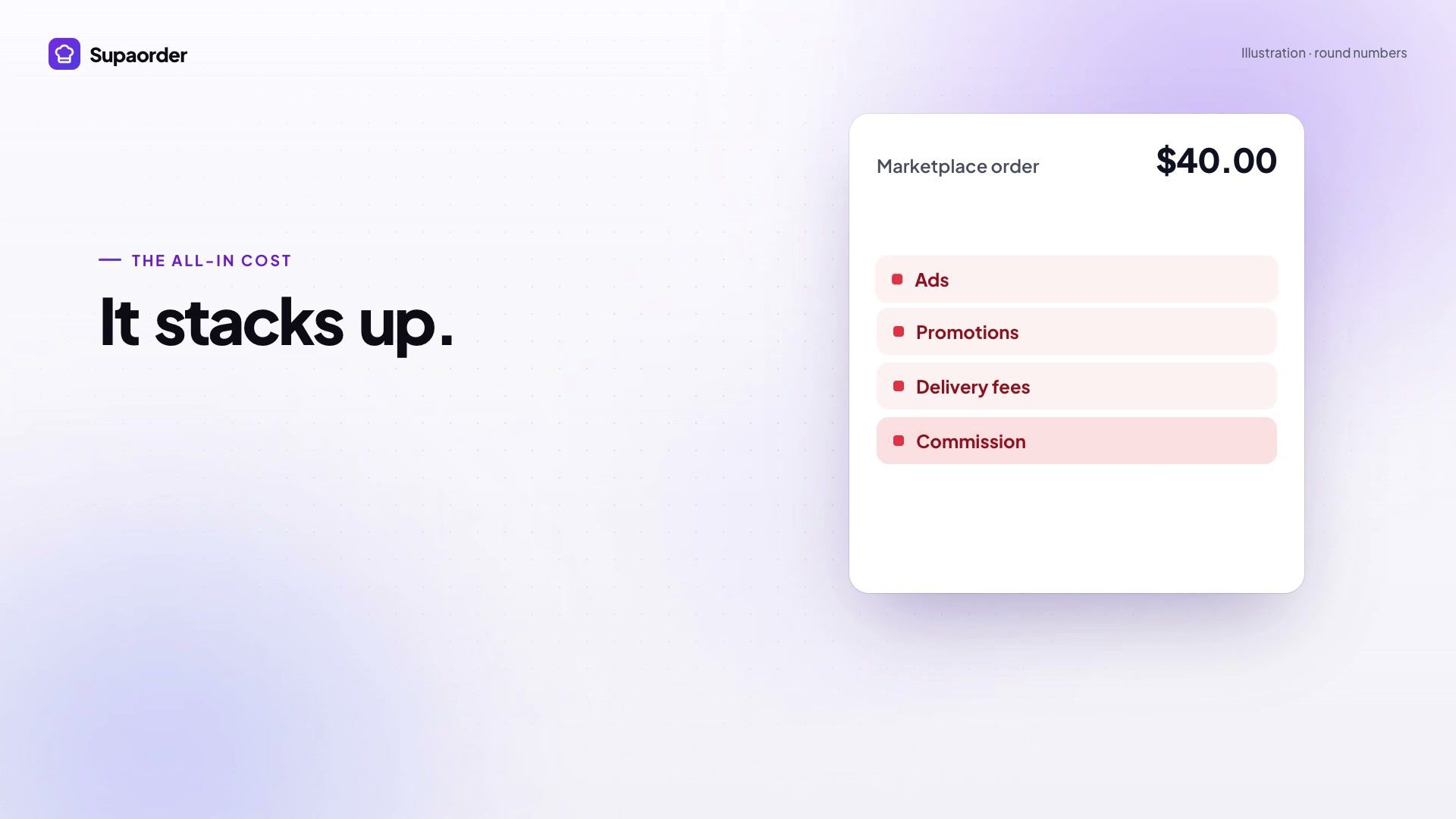
Most third-party marketplaces still charge restaurants a percentage of every order. Depending on your plan and market, that typically lands between 15% and 30% per order, with full-service tiers (delivery included, better placement) at the top of that range. The rate cards are public: DoorDash’s Marketplace plans run 15%, 25% and 30% delivery commission, and Uber Eats prices its Lite, Plus and Premium plans at 20%, 25% and 30%.
The math gets uncomfortable quickly:
| Monthly online revenue | At 15% commission | At 25% commission | At 30% commission |
|---|---|---|---|
| $10,000 | $1,500 | $2,500 | $3,000 |
| $20,000 | $3,000 | $5,000 | $6,000 |
| $50,000 | $7,500 | $12,500 | $15,000 |
For context, the average restaurant’s profit margin sits in the single digits — the National Restaurant Association puts a typical restaurant’s pre-tax profit margin at roughly 5%, with 42% of operators unprofitable in 2025. A 25% commission on a digital channel can mean the channel grows your revenue while shrinking your profit.
The Costs That Don’t Show Up on the Rate Card
Commission is only the visible part. In practice, restaurants on third-party platforms also absorb:
- Placement and advertising fees. Organic visibility inside a crowded marketplace keeps falling; staying near the top of search results increasingly requires paid promotion. DoorDash Sponsored Listings work as an auction — you bid per order and set a daily budget — which is a cost on top of commission.
- Price pressure from comparison shopping. Your menu sits next to your competitors’. Discounts become table stakes, and the platform decides whose promotion gets surfaced.
- Payment processing layered on top of commission on some plans.
- Chargebacks and refund policies you don’t control. When the platform sides with the customer, the cost usually lands on the restaurant.
- Tablet chaos and re-keying errors if orders don’t flow into your POS — staff time is a real cost.
The Cost Nobody Invoices You For: Customer Data
The most expensive thing about third-party apps isn’t the commission — it’s that the customer relationship belongs to the platform. New York City passed a law in 2021 forcing delivery apps to hand customer data back to restaurants precisely because they do not do it voluntarily; a federal appeals court struck that law down in August 2026 on First Amendment grounds, leaving restaurants back where they started. You typically don’t get usable emails or phone numbers, can’t market to your own regulars, can’t run loyalty on your terms, and can’t tell your best customer from a one-time visitor.
That data is exactly what powers repeat business. Loyalty programs, win-back campaigns, birthday offers, and reorder reminders all depend on knowing who your customers are. On a marketplace, that knowledge accrues to the marketplace.
When Third-Party Apps Still Make Sense
Being clear-eyed cuts both ways. Marketplaces are genuinely useful for:
- Discovery. New customers who’ve never heard of you search there first.
- Overflow demand at times you couldn’t serve with your own delivery anyway.
- New market entry, where you have no local audience yet.
The mistake isn’t being on the platforms — it’s letting them remain your only digital channel, paying acquisition-level fees on loyal regulars who would happily order from you directly.
The 2026 Playbook: Marketplace for Discovery, Direct for Loyalty
The pattern that works looks like this:
- Stand up your own branded ordering channel — web and mobile apps under your name and domain, with your menu, your pricing, and your data.
- Convert marketplace customers into direct customers. Box inserts, receipt QR codes, a “skip the fees — order direct” offer. Even converting a fraction of regulars changes the economics.
- Make direct ordering the better deal. Loyalty points, members-only items, and direct-only promotions cost a fraction of the commission you’d otherwise pay.
- Keep the marketplaces for discovery, priced to account for their fees.
What the Direct Channel Costs Instead
This is where flat-fee platforms change the equation. With Supaorder’s pricing, the direct channel is $129 per location per month in the US — zero commission, unlimited orders. Against a 25% commission, the break-even is $516 of monthly online orders; everything beyond that is savings. At $20,000/month in direct orders, that’s roughly $4,870/month kept versus the same volume through a 25% marketplace — use the savings calculator for your own numbers, or follow the break-even arithmetic step by step on last month’s statement.
Just as important: every order on your own channel comes with the customer’s consent-based contact details, order history, and preferences — the raw material of repeat business.
Making the Switch Without Disruption
A direct channel doesn’t need a six-month IT project. A white-label platform handles the apps, the payments, the dispatch and the in-store hardware, while you keep running the restaurant:
- Branded web and mobile apps deployed under your name in days, not months
- Your existing workflow — orders flow to a kitchen display or your POS
- Delivery flexibility — in-house drivers, local couriers, or both
- Built-in loyalty and marketing tools to put your new customer data to work
If you want the technical details, the Supaorder documentation covers setup, menu management, payments, and delivery configuration end to end.
The Bottom Line
Third-party apps are a tool — a costly one. In 2026, the restaurants winning online treat marketplaces as paid discovery and route loyalty through a channel they own. The commission you save on regulars funds everything else: better margins, real loyalty rewards, and marketing you control.
Comparing direct-ordering vendors rather than marketplaces? Start with how Supaorder stacks up against ChowNow, Flipdish and UpMenu, where every figure is quoted from the other vendor’s own pages and dated. Or, to see what your own branded channel would look like, book a free demo — many restaurants go live in as little as 48 hours.