By Supaorder Team — who we are
Flat Fee vs Commission at 200/500/1,000
The same three order volumes run through a commission rate and a flat monthly fee, with the break-even in orders and the caveats that change the answer.

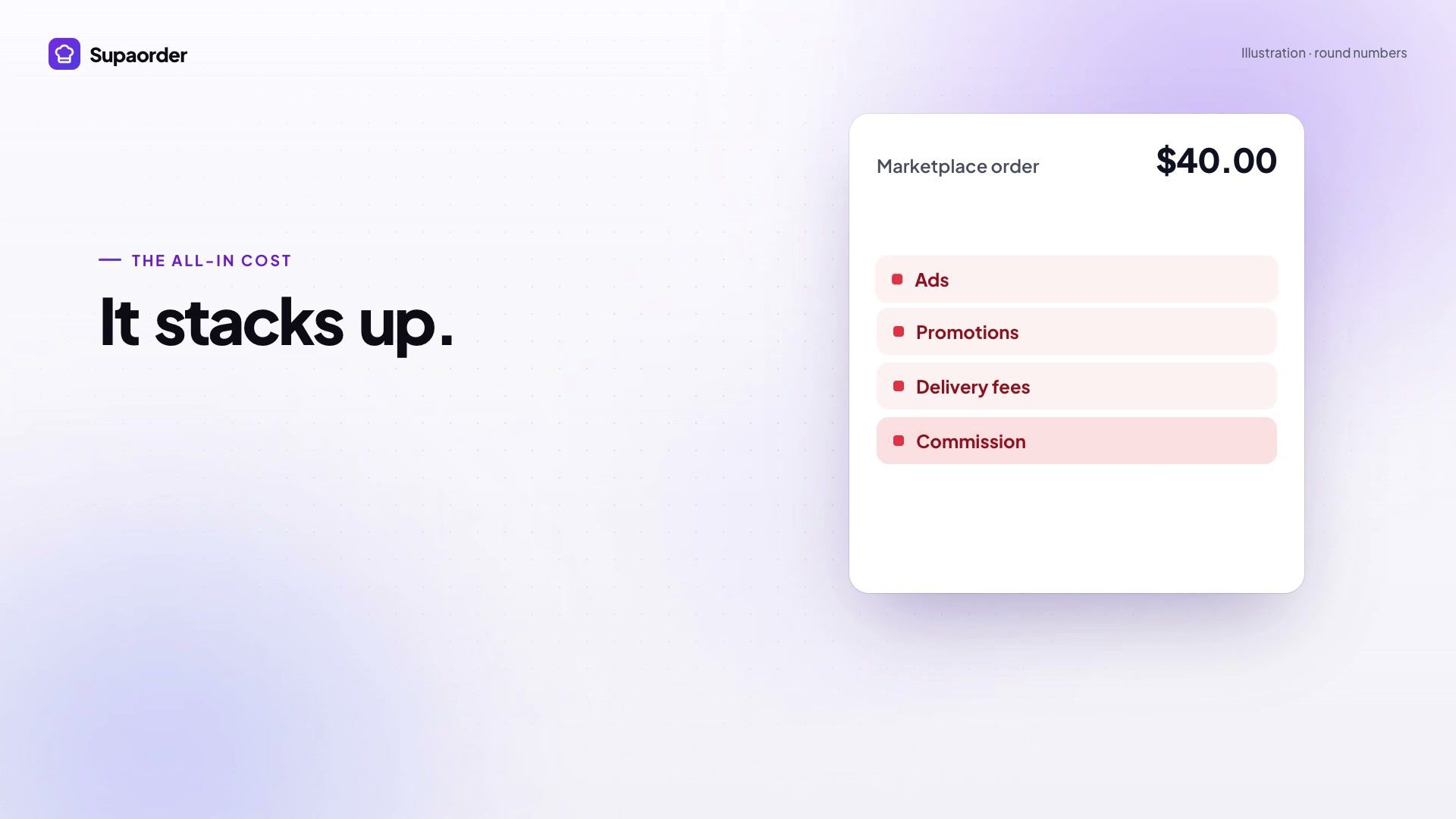
Percentage pricing and flat pricing are not better or worse than each other. They are shaped differently, and the shape is the whole decision: one cost rises with every order you take, the other does not move. Which is cheaper depends entirely on how many orders you are talking about.
So let’s talk about specific numbers. Three volumes, one average ticket, the published rates on both sides, and no adjectives.
The inputs
The commission side. Every rate here comes from the platform’s own page, read on 2 September 2026: DoorDash publishes 15%, 25% and 30% delivery commission across its Basic, Plus and Premier plans; Uber Eats publishes 20%, 25% and 30%. DoorDash also publishes a $0 monthly fee, a $0 signup fee and no contract, so on that side you pay nothing in a month with no orders. Grubhub prices differently again — a marketing commission of 5%, 15% or 20% with delivery billed separately — so it does not map onto a single number, and it is left out of the table rather than approximated into it.
The flat side. Supaorder is $129 per location per month in the United States, with no commission and no cap on order volume. The rate falls to $109 from your fourth location and $89 from your tenth, and each market has its own published price rather than a conversion of the US one.
The assumptions, stated so you can change them: a $30 average ticket, a single location, and the comparison run on commission alone. Card processing is deliberately excluded from both sides — you pay it either way, and on a direct channel you pay it straight to your own processor with nothing added in between.
The table
Three volumes, three commission rates, one flat fee.
| Orders a month | Revenue | At 15% | At 25% | At 30% | Flat fee |
|---|---|---|---|---|---|
| 200 | $6,000 | $900 | $1,500 | $1,800 | $129 |
| 500 | $15,000 | $2,250 | $3,750 | $4,500 | $129 |
| 1,000 | $30,000 | $4,500 | $7,500 | $9,000 | $129 |
And the same rows read as what stays in the business:
| Orders a month | vs 15% | vs 25% | vs 30% |
|---|---|---|---|
| 200 | $771 | $1,371 | $1,671 |
| 500 | $2,121 | $3,621 | $4,371 |
| 1,000 | $4,371 | $7,371 | $8,871 |
The second table is the one worth sitting with, because of what it does not do: it does not get better per order as you grow, it gets better in total. The commission column triples between the first row and the third. The flat column does not move at all.
Where the lines cross
The crossover is a single division — monthly fee divided by commission rate — and at $129 it lands well below any of these volumes:
| Commission rate | Break-even revenue | Break-even orders at a $30 ticket |
|---|---|---|
| 15% | $860 | 29 |
| 25% | $516 | 18 |
| 30% | $430 | 15 |
Fifteen to twenty-nine orders. Not fifteen hundred. That is the part most operators get wrong when they estimate it in their heads: they picture needing to move the whole channel, when the fee is covered by roughly one order a day. Everything above that line is arithmetic in your favour, and the 200-order row is already six to thirteen times past it.
Three honest caveats
Use your effective rate, not the plan rate. The published percentage is the floor. Add ad spend, promotion funding and any separately billed delivery or processing lines, then divide by gross sales from that channel — that is the number to put in the middle column. The full cost stack walks through which lines belong in it. Effective rates usually land above the plan rate, which moves the break-even down, not up.
Volume does not transfer by itself. This table compares the same orders through two channels. It says nothing about whether an order that arrived through a marketplace would have arrived at all without one — and for a genuinely new customer, often it would not. Marketplace discovery is a real service you are buying at an acquisition price. The orders that transfer cleanly are the repeat ones: people who already know your name, already like the food, and are paying a discovery fee on a discovery that happened months ago.
The flat fee is a fixed cost, which cuts both ways. In a slow February you still pay it, where a commission plan would charge you nothing. If your volume is genuinely below the break-even line — a new site, a seasonal window, a location still finding its feet — percentage pricing is the cheaper structure and it is not close. That is the honest case for it, and it is why the $0-a-month model exists.
Running it on your own numbers
- Take last month’s statement, and not an introductory month — DoorDash and Uber Eats both publish 0% opening periods, and that month does not describe the channel.
- Add every fee line plus ad and promotion spend, divide by gross sales from that channel. That is your effective rate.
- Divide $129 by it. That is your break-even revenue.
- Divide by your average ticket. That is the number of orders you need to move.
- Compare that number with how many of last month’s orders came from customers who had ordered from you before.
Step five is where the decision actually gets made. If your repeat orders comfortably exceed your break-even order count — and at fifteen to twenty-nine orders, for most established restaurants they do several times over — then the marketplace is being paid an acquisition fee on customers it is no longer acquiring.
The pattern that follows from that is not “leave the marketplaces”. It is: marketplaces for strangers, your own channel for regulars, priced so the regulars have a reason to switch. Setup does not change the arithmetic either — menu setup and migration are included, and the standard $500 setup fee is currently waived for early customers.
If you would rather move a slider than open a spreadsheet, the savings calculator runs this same division on your revenue and your effective rate. Or book a demo and bring a statement — the break-even takes about five minutes to work out, and you will leave knowing exactly where your crossover sits.