By Supaorder Team — who we are
What a Marketplace Order Really Costs
The full cost stack behind one marketplace order — commission, delivery, promotions, ads and menu markup — quoted from each platform's own rate card.

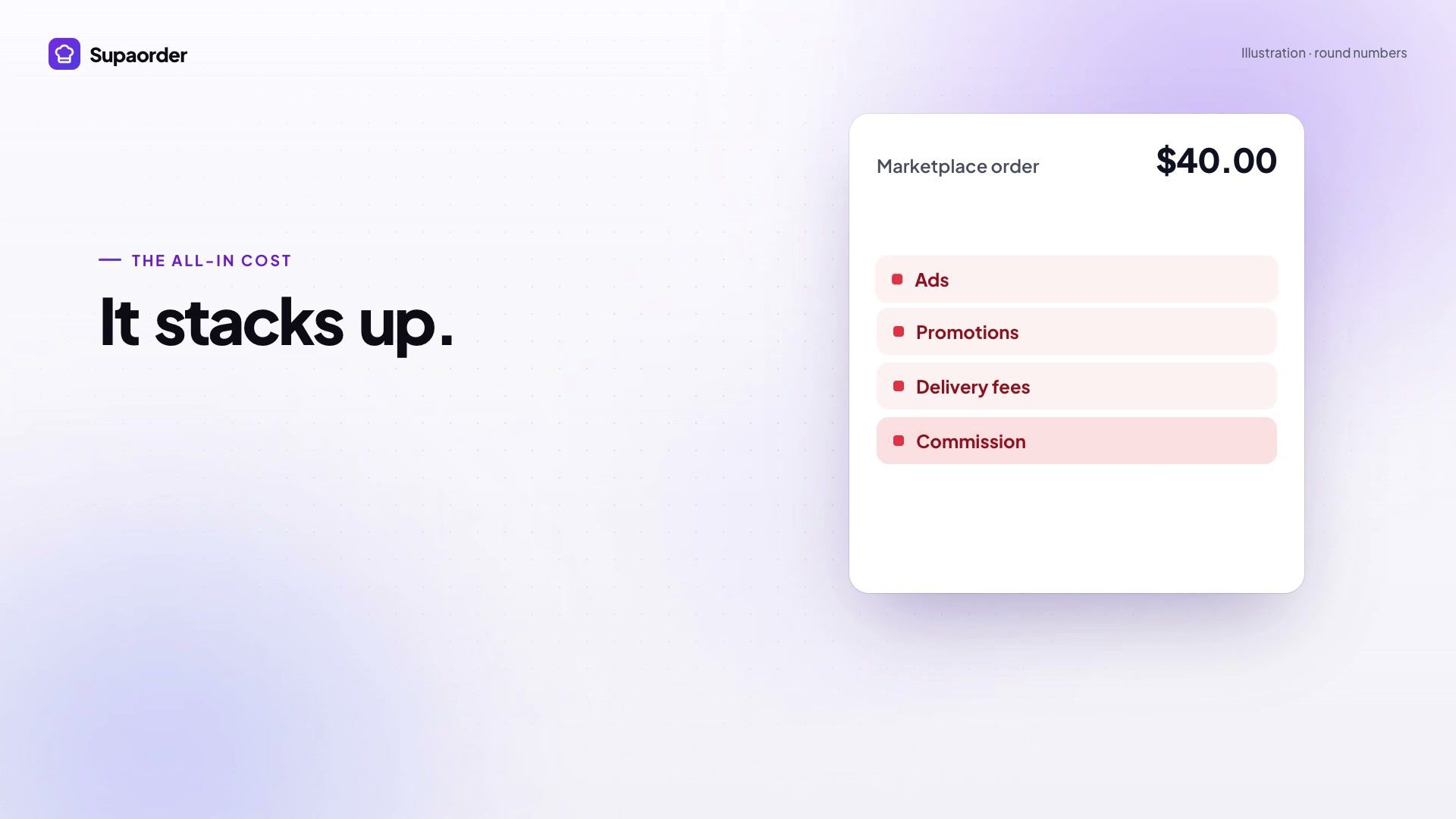
A marketplace order has one number on the rate card and several more underneath it. None of the others are secret — every platform publishes them — but they sit on different pages, and nobody adds them up for you. This post does that, using only figures each company publishes about itself, with the date each one was checked.
Every rate below was read from the platform’s own page on 2 September 2026. Rates change and vary by market, so treat this as a method rather than a permanent table: the point is which lines belong in the stack, not what they happen to say today.
Layer 1: the commission on the order
This is the number everyone knows, and it is genuinely the biggest one. All three of the large US marketplaces publish a plan table.
| Platform | Plan | Delivery | Pickup |
|---|---|---|---|
| DoorDash | Basic / Plus / Premier | 15% · 25% · 30% | 6% |
| Uber Eats | Lite / Plus / Premium | 20% · 25% · 30% | 7% |
| Grubhub | Basic / Plus / All-Access | 5% · 15% · 20% marketing commission | not stated on that page |
A few things are worth reading carefully rather than skimming.
The plan you are on is a visibility decision, not just a price. DoorDash describes its higher plans as reaching customers farther away; Grubhub is explicit that the marketing commission determines the exposure you get. So the cheapest plan is cheapest per order and quietest in the app. That is a real trade, and it is the trade the platforms are actually selling.
Grubhub’s headline number and DoorDash’s are not measuring the same thing. Grubhub separates a marketing commission from a delivery fee — its FAQ states that “if you use our delivery service there’s a 10% delivery fee” (Grubhub, checked 2 September 2026) — so a Plus plan at 15% marketing plus 10% delivery is not comparable to a 15% all-in rate. Uber Eats splits it the other way: its marketplace fee covers delivery, and a separate 15% self-delivery rate applies if you use your own drivers.
Pickup is the cheapest thing on any of these platforms, and it is easy to forget it exists. DoorDash’s 6% pickup rate carries a condition stated in its own footnote — pickup menu prices must match your in-store prices.
Layer 2: promotions and introductory rates
DoorDash and Uber Eats both open with a commission-free introductory period — DoorDash publishes 0% for 7 days on Basic and 30 days on its two larger plans; Uber Eats publishes a 0% intro rate for 30 days on Plus and Premium. Those are real and worth taking. They are also why the first month’s statement is a bad basis for any decision: it is the one month that does not represent the channel.
Running promotions — a discounted item, free delivery over a threshold — is a separate cost you fund yourself. It rarely appears as a fee line; it appears as a smaller number in the revenue column, which is harder to notice and just as expensive.
Layer 3: paid placement
Organic position inside a marketplace is finite, so all three sell placement. DoorDash’s Sponsored Listings are billed per order rather than per click or impression, which the company states directly: “you’ll only be charged for orders placed through your ad — not for clicks or impressions” (DoorDash, checked 2 September 2026).
Pay-per-order is a genuinely restaurant-friendly billing model — you are not paying for browsers who never convert. It is still a cost that sits on top of commission on the orders it produces, so an order that arrives through an ad carries two charges, not one. When you compute an effective rate, ad spend belongs in the numerator.
Layer 4: menu-price inflation
Many restaurants raise their marketplace prices to absorb the commission. That is an understandable response, and the platform whose fees prompt it publishes the clearest evidence against it: DoorDash’s own guidance says that in an internal 2023 study of more than 4,500 restaurants, those that mark up menu prices “can see up to 37% fewer sales and up to 78% lower reorder rates” (DoorDash, checked 2 September 2026). The same page sets a 10% ceiling on markup for its Most Loved program.
So the markup is a cost in two directions at once: customers pay more, and the evidence suggests fewer of them come back. It rarely shows on a statement at all, which is exactly why it belongs in this list.
Layer 5: payment processing and the operational tail
Card processing is charged somewhere in every model — inside the commission on some plans, as a separate line on others. Grubhub, for instance, describes an order processing fee covering card processing and fraud monitoring as a distinct charge from the marketing commission.
Then there is the part with no invoice: a tablet that is not connected to your till means someone re-keys every order, and re-keyed orders are where mistakes and refunds come from. If your marketplace orders already flow into your POS, this line is near zero. If they do not, it is a wage.
What the marketplaces are genuinely good at
It would be a poor accounting that only counted costs.
- There is no fixed cost. DoorDash publishes a $0 monthly fee, a $0 signup fee and no contract (DoorDash, checked 2 September 2026). You pay when orders arrive and nothing when they do not — exactly the right shape for a channel you are testing.
- Discovery is real and hard to replicate. On the same page, DoorDash states that more than 55% of orders come from browsing rather than search. Those are people who did not know you existed. No direct channel produces that.
- The introductory rates are worth taking, particularly on a new location where you have no local audience at all.
- Overflow demand costs you nothing to leave on. A busy Friday you could not have served with your own drivers is margin you would not otherwise have had.
Building your own version of this table
The useful number is not any published rate. It is your effective rate, which is the whole stack divided by what the channel actually paid you:
effective rate = (commission + delivery fees + ad spend + promotion funding
                  + processing) ÷ gross marketplace sales
Pull one month’s statement — not the introductory month — add your ad and promotion spend from the marketing tab, and divide. Most operators find the answer several points above the plan they thought they were on. Then do the same arithmetic for what a marketplace order costs you net of markup: if you list at 15% above your dine-in prices, some of that commission is being paid by your customers, and some of it is being paid in orders that did not happen.
Once you have the effective rate, the interesting question stops being “is this expensive” and becomes “which orders should go through it”. Discovery is worth an acquisition-level fee. A regular who orders every Thursday and already knows your name is not discovery — and that is the arithmetic the break-even post works through at three volumes, against Supaorder’s own published price.
If you want the flat-fee half of the comparison run on your numbers, the savings calculator does the division, and a demo is thirty minutes with a statement open.