By Supaorder Team — who we are
Restaurant Digital Marketing You Actually Own
The half of restaurant marketing that does not depend on renting an audience: your customer list, your app, and the three prompts that bring people back.

Most restaurant marketing advice is about renting attention — post more, bid more, get reviewed more. It is not wrong and it is not the interesting half, because everything in it stops working the moment you stop paying or posting.
This is about the other half: the marketing you can only do once the customer relationship is yours. It is smaller, duller and considerably more reliable, and almost nobody writes about it because there is nothing to sell you.
The line that divides the two
Ask one question about any marketing activity: if I stop, does the value stop?
Instagram, paid social, aggregator promotions and the marketplace’s own “recommended near you” slot are all rented. They perform while funded and go quiet when not. That is a legitimate thing to buy — it is how a new site gets its first hundred customers — but it never accrues.
Your customer list, your ordering app on someone’s home screen, and the permission to contact them are owned. They cost something to acquire and then keep working. A restaurant with four thousand contactable past customers has an asset; a restaurant with forty thousand Instagram followers has an audience it borrows from a platform that decides who sees the post.
The uncomfortable version: if you take orders only through marketplaces, you have been buying rented attention at 15–30% of every order and have nothing to show for it afterwards. The order happened. The relationship went to the marketplace.
What owning the relationship actually gets you
Three things, in order of how much they are worth.
One: you can contact people who have already paid you. This is the whole game. A past customer converts several times more readily than a stranger, and reaching them costs a notification rather than a bid. Every marketing tactic below depends on this and none of it is available to a restaurant whose customers belong to an app.
Two: you know what they ordered. Not demographics — actual orders. Who orders on Fridays, who has not been back in six weeks, who always adds the same side, who spent forty pounds once and never returned. That is the difference between a promotion sent to everybody and one sent to the two hundred people it applies to.
Three: you can change the offer without asking permission. No marketplace approval, no promotional calendar you do not control, no algorithm deciding whether your discount gets seen.
The three prompts that do most of the work
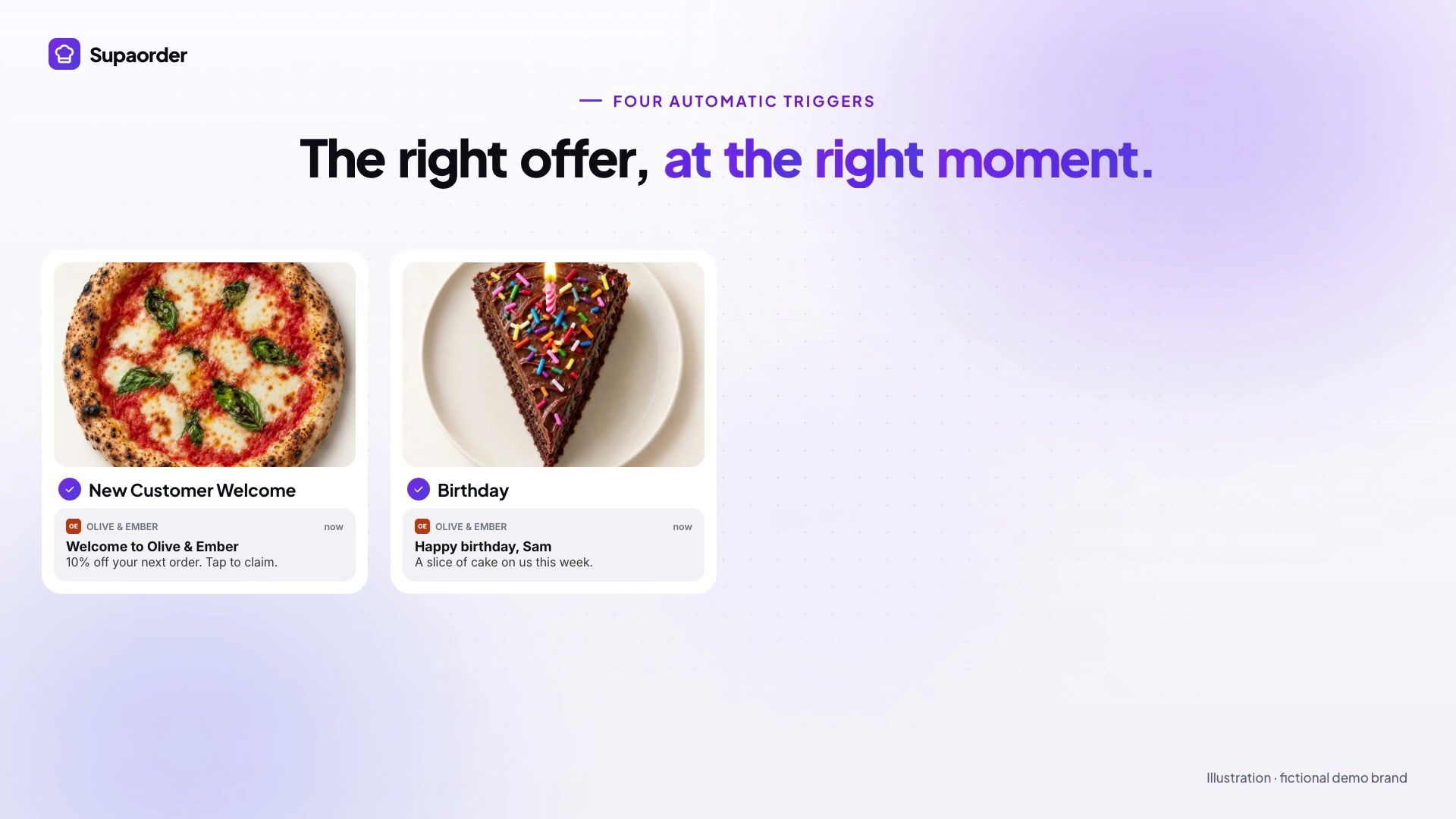
Almost all the value in owned restaurant marketing comes from three messages. They are unglamorous, they are largely automatic once configured, and they beat any campaign you will run manually.
The reorder prompt. Someone ordered fourteen days ago and has not come back. One notification, naming what they had. It works because it removes a decision rather than making an offer — most people do not fail to reorder because they went elsewhere, they fail because they did not think of you at six o’clock.
The lapse prompt. A regular has gone quiet for longer than their own normal gap. This one is worth doing carefully: the point is to notice the person who used to order weekly and stopped, not to spray the whole list. A restaurant with a year of order history can define “lapsed” per customer rather than by a fixed rule, and that is a genuinely different message.
The first-reorder push. The gap between a first order and a second is where most restaurants lose people. A customer who orders twice is dramatically more likely to order ten times. If you do only one of these three, do this one.
None of the above requires a campaign, a designer or a monthly spend. They require a customer list you own and a way to reach it.
What to actually do with the list
Segment by behaviour, not by demographic. You do not know your customers’ ages and you do not need to. You know their order history, which is better. New · active · lapsing · lapsed · high-value is five segments and covers nearly everything worth doing.
Send less than you want to. The temptation with an owned channel is to use it, because it is free. Free to send is not free to spend — you are spending attention, and it does not refill. A restaurant sending weekly is training people to ignore it.
Give the app a reason to stay installed. An ordering app that only takes orders gets deleted at the next storage cleanup. Order history, saved favourites, a loyalty balance and one-tap reorder are the things that make deletion feel like a loss.
Ask for the review after the good order, not on a schedule. You know which orders went smoothly. Ask those customers.
Where the rented half still belongs
This is not an argument against paid marketing, and a page that made it would be wrong.
You need rented attention for discovery. Nobody is on your customer list before their first order, and there is no owned channel that reaches a stranger. Marketplaces, local search and paid social are how the first order happens — the mistake is treating them as the whole strategy rather than the top of it.
Local search is worth more than social for most restaurants. A complete, current Google Business Profile with real photographs and correct hours converts better than any amount of posting, and it is closer to owned than the rest of the rented half.
And a marketplace listing is a fine acquisition channel if you treat the commission as a customer-acquisition cost rather than a tax. The arithmetic only works if you then move those customers to your own channel; otherwise you are paying acquisition cost on the same customer forever.
What this will not fix
Marketing does not compensate for a menu that photographs badly, a checkout nobody can finish, or forty-minute delivery on a twenty-minute promise. Those decide whether direct ordering works, and all three are operational rather than promotional.
It also does not work at very small volume. A restaurant taking a handful of online orders a week does not have a list worth segmenting, and the honest advice there is to get the volume first — through the rented channels — and build the owned half once there is something to own.
Where to start
Count how many contactable past customers you currently have. If the answer is “none, they are all on the marketplace’s list”, that number is the actual finding and everything above is unavailable to you until it changes.
If you have a list, turn on the first-reorder push before anything else. It is one setting and it addresses the point where most restaurants lose the most people.
The economics of getting to that point are worked through in when direct ordering pays for itself, and what a marketplace order really costs is the same question from the other side.